Jardin d’acclimatation
Chanson douceThe Jardin d’acclimatation is the setting of a family outing that reveals the tenderness and danger intertwined in Louise’s bond with Mila and Adam. A bright, warm September day ends with Mila briefly missing, Louise frantic, and a reunion that becomes an embrace too tight to bear. Rather than telling Myriam what happened, Louise and Mila keep silent, leaving the incident to bind them through a secret and a mutual grievance.
Setting and Outing
At the end of a mild, luminous September, Louise decides to take the children to the Jardin d’acclimatation. The outing belongs to a larger pattern of Wednesdays spent coaxing them away from home: earlier in the month she has taken them to parks, to watch fish at the aquarium, and boating on the lake in the Bois de Boulogne. On that boat trip, she tells Mila that the floating algae are really the hair of a vengeful fallen witch. The excursion to the amusement park continues the same inventive, indulgent care, but its pleasures make the later panic all the more stark.
Louise brings the children to the park by metro. They love the train so much that she has to stop them running along the platform and rushing into the carriage; inside, Adam copies Mila as she clings to a pole and pretends to drive. At the Jardin d’acclimatation, Louise runs and plays with them, buys ice creams and balloons, and photographs them lying on a carpet of leaves, bright yellow and blood-red. Mila asks why some trees turn golden while others seem to pass from green straight to dark brown. Louise cannot explain and says they will ask her mother. In this small exchange, care does not mean knowing everything: Louise can make a day vivid, but she recognizes the boundary of what she can answer.
Play and Unease
The park’s attractions turn fear into shared excitement. In the rides, the children shriek with both terror and delight; Louise, who is afraid of heights, holds Adam tightly on her knees as the train plunges through dark tunnels and down steep slopes. A balloon rises into the sky, and Mickey has become a spaceship. The details give the outing a child’s shifting scale, where a ride can be frightening and thrilling at once, and an ordinary balloon can be transformed by imagination.
They picnic on the grass. Mila teases Louise for being afraid of the large peacocks nearby. The blanket is an old wool one that Myriam had left rolled beneath her bed; Louise has cleaned and mended it before bringing it along. The children and their nanny fall asleep together on the grass. When Louise wakes, Adam is pressed against her and the children have pulled the blanket over themselves. She is cold, but the decisive absence is Mila: the girl is no longer beside them.
Mila Goes Missing
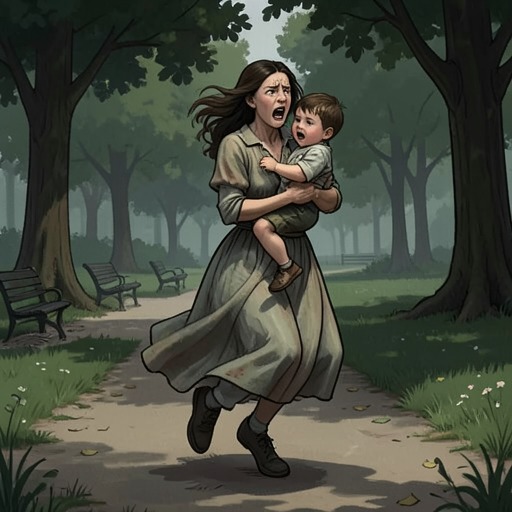
Louise calls Mila, then begins to shout and run. People turn to ask whether she needs help, but she does not answer. Carrying Adam, she circles the rides and runs past the shooting gallery; tears rise, her jaw trembles, her skull aches, and her knees begin to give way. The search strips away the ease of the outing. For a moment she imagines herself about to collapse, unable to move or speak, while the surrounding visitors hold their own children close.
She eventually spots Mila at the end of an avenue, eating an ice cream on a bench beside a woman in her sixties. The stranger has drawn the child close and reproaches Louise, asking what she had been doing and how Mila could have been left alone. She threatens to ask the girl for her parents’ number, convinced they would not approve. Her rebuke places Louise under the gaze of someone who sees a possible lapse in supervision, not the intimacy that has shaped the day.
Mila breaks free of the woman’s hold, pushes her away, and runs to Louise’s legs. Louise lifts her, kisses her cold neck, strokes her hair, and apologizes for her own negligence. Calling Mila her little one, her angel, and her kitten, she covers her with kisses and holds her to her chest. The stranger watches, then leaves with a final warning to be more careful next time. The reunion appears to settle the danger, but Louise’s relief soon becomes something more forceful.
The Embrace and Its Aftermath
As the woman walks away, turning back two or three times, Louise smiles at her in gratitude and tightens her arms around Mila. She squeezes the child’s chest until Mila begs her to stop because she cannot breathe; Mila struggles and kicks, but Louise holds fast. Then, in a calm, icy voice, Louise warns her never to wander off again. She tells Mila that a bad man might steal her, hide her, keep her for himself, and make sure she never sees her parents again. The threat is presented as a warning meant to keep Mila close, but its language makes separation terrifying and turns Louise’s fear into fear imposed on the child.
When Louise is about to put her down, pain shoots through her shoulder: Mila bites her until she bleeds and clings to her arm. The park’s brief disappearance has therefore produced more than a frightened search and a safe recovery. The child physically resists the embrace that was supposed to protect her, giving visible force to the conflict between comfort and restraint.
That evening Louise does not tell Myriam either about Mila’s disappearance or about the bite. Mila is silent too, although Louise has not instructed or threatened her to keep quiet. Each now has a grievance against the other, yet their silence also gives them a secret in common. The Jardin d’acclimatation thus becomes more than a recreational setting: the rides, the picnic blanket, the lost child, and the bite mark trace a shift from shared play to an uneasy intimacy in which affection, fear, and possession cannot be cleanly separated.